The Principles of Green Chemistry
Our latest blog series is designed to guide chemists towards a greener, more sustainable laboratory. Each of our blogs will explore one principle. If you missed previous ones, they can be found here.
Fifth Principle: Safer Solvents and Auxiliaries

The use of auxiliary substances (e.g., solvents, separation agents, etc.) should be made unnecessary wherever possible and innocuous when used.
After a bit of a “pass” granted from issues outlined in the previous Principle, this principle’s objective and the outcome of green(er) peptide synthesis are undoubtedly within the abilities of most chemists.
A Crucial “How-to” Principle
As in previous entries, we refer to the American Chemistry Society’s site, where all the principles are set forth.”1
In the first blog post for this series, Berkley Cue stated that the first principle is the most important, and the rest are “how-to.”1 Close readers have also noticed that solvents play an outsized role in that greener how-to and “account for 50 – 80 percent of the mass in a standard batch chemical operation, depending on whether you include water or you don’t. Moreover, solvents account for about 75% of the cumulative life cycle environmental impacts of a standard batch chemical operation.”1 This principle addresses alternative solvents and auxiliaries.
Fortunately, in contrast to the lack of guidance with the previous principle, there is quite a bit of literature for safer solvents. One article, “Making Solid-Phase Peptide Synthesis Greener: A Review of the Literature,” is an excellent place to start and the illustration for their abstract is a nice summation as well. 2
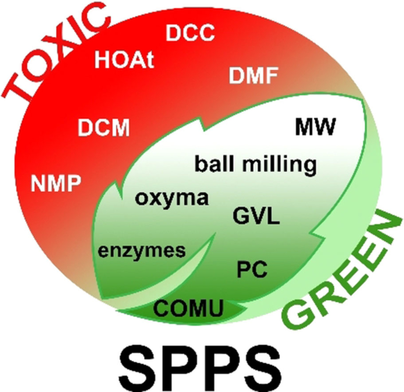
Image from K.G. Varnavaand, V. Sarojini
Making Solid-Phase Peptide Synthesis Greener: A Review of the Literature, Chem. Asian J. ,14,1088 –1097 (2019). DOI:10.1002/asia.201801807
Another article, “Greening Fmoc/tBu Solid-Phase Peptide Synthesis,” that reviews alternatives to DMF, NMP, and CH2Cl2, is by the team of Othman Al Musaimi, Beatriz G. de la Torre, and Fernando Albericio. We can endorse their conclusion “that in many cases green solvents do not impair the synthetic process and that their adoption in current synthetic schemes will be translated into a smaller impact on the environment and on human health.”2
Another “solvent swap” article worth studying is “N-Butylpyrrolidinone Forfor Solid-Phase Peptide Synthesis Is Environmentally Friendlier and Synthetically Better Than DMF.”3
For CGT, this could involve using aqueous-based cell culture media or safer cryopreservation solutions.
Trading Impacts
These are just a few of the dozens of articles that aid in fulfilling this Principle. Depending on your current less-green solvent of choice, a search of the existing literature will be the first place to look for your solvent swap solution.
While it is not often straightforward to replace a solvent with a greener one, recovery and re-use strategies can be implemented to maximize the use of the solvent and significantly reduce the need for fresh solvent, and consequently also reduce the generated waste. Emission control devices can be quite efficient at capturing the vapors that can be, in turn, condensed, “cleaned up,” and reinjected in the process. Optimization of the chemistry process to run more concentrated, combined with recovery and reuse strategies, can do a lot of good for the emission and carbon footprint.
We conclude with another quote from Dr. Concepción (Conchita) Jiménez-González, Director, Operational Sustainability, GlaxoSmithKline on the ACS 12 Principles site that encapsulates your alternatives:
“We will always need solvents, and with many things in chemical processes, it’s a matter of impact trading. Optimize a solvent according to one green metric, and many times, there are three others that don’t look so good. The object is to choose solvents that make sense chemically, reduce the energy requirements, have the least toxicity, have the fewest life cycle environmental impacts, and don’t have major safety impacts.”1
References
Resources