
The Principles of Green Chemistry
Our latest blog series is designed to guide chemists towards a greener, more sustainable laboratory. Each of these blogs explores one principle. If you missed previous ones, they can be found here.
Eighth Principle: Reduce Derivatives
The full definition of this principle is: “Unnecessary derivatization (use of blocking groups, protection/deprotection, temporary modification of physical/chemical processes) should be minimized or avoided, if possible , because such steps require additional reagents and can generate waste.”1 As we have done with previous principles, a closer reading may shed some light on the intent. The key words in this definition are the adverbs ‘unnecessary’ and ‘temporary. Quite often, chemists employ protecting groups on one or several parts of molecules while modifying a specific function as a way to avoid deconstructing the molecule. Then these protecting groups will be removed at a later step to “reactivate” the functions and obtain the desired chemical activity. Unfortunately, these operations require more reagents and materials as some yield loss is always experienced, and additional waste is generated. Therefore, a “green” chemist should strive to design a synthetic route that minimizes or best eliminates the use of such techniques. By utilizing new technologies, such as selective catalytic reactions or enzymes, a more direct synthetic route can be designed, reducing the number of steps and overall PMI.
As an example, Peter J. Dunn, Green Chemistry Lead at Pfizer, cited: “A great example of the use of enzymes to avoid protecting groups and clean up processes is the industrial synthesis of semi-synthetic antibiotics such as ampicillin and amoxicillin.1-3” Dunn continues demonstrating the principle by describing that, “In the first industrial synthesis, Penicillin G (R=H) is first protected as its silyl ester [R = Si(Me)3] then reacted with phosphorus pentachloride at -40o C to form the chlorimidate (1) subsequent hydrolysis gives the desired 6-APA from which semi-synthetic penicillins are manufactured.

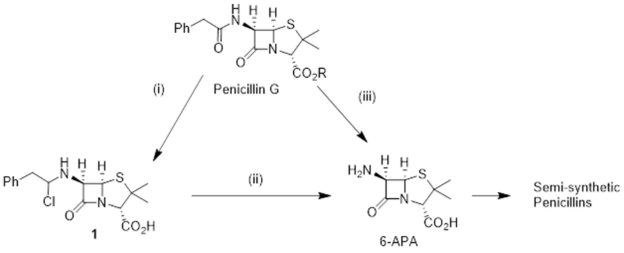
Industrial synthesis of penicillin
- TMSCl then PCl5, PhNMe2, CH2Cl2, -40oC
- (ii) n-BuOH, -40o C, then H2O, 0oC
- (iii) Pen-acylase, water
This synthesis has mainly been replaced by a newer enzymatic process using pen-acylase. This synthesis occurs in water at just above room temperature. The new synthesis has many advantages from a green perspective, one of which is that the silyl protecting group is not required.
More than 10,000 metric tons of 6-aminopenicillanic acid are made every year, and much of it by the greener enzymatic process, so this is a fantastic example of green chemistry making a real difference.”1-3
Obviously, when using protecting groups is inevitable, using green and/or renewable reagents should be at least considered to minimize the carbon footprint and improve the “greenness” of the synthetic process.
Regardless of the compound, chemists should always consider the synthetic route holistically and provide a fair assessment of each possible route to determine the optimum process in terms of purity, yield, raw material usage, waste generated, sustainability, and ultimately cost.
References
Resources