Our latest blog series is designed to guide chemists towards a greener, more sustainable laboratory. Each of our blogs will explore one principle. If you missed previous ones, they can be found here.
Twelfth Principle: Inherently Safer Chemistry for Accident Prevention
Substances and the form of a substance used in a chemical process should be chosen to minimize the potential for chemical accidents, including releases, explosions, and fires.1
This final principle in the series is a clear call to anticipate and mitigate risks before they occur. Safety must be the paramount concern for everyone involved in chemical manufacturing. Whenever feasible, less hazardous components should be selected to reduce the likelihood and severity of accidents. Chemical accidents often result in the release or spill of toxic substances, either as a primary or secondary consequence. A primary consequence occurs when the hazardous chemical itself causes the accident. A secondary consequence arises when an accident involving one substance leads to the release of a comparable or potentially more dangerous chemical. For safety managers and chemical cleanup crews, this creates a worst-case scenario, multiple hazards to contain and resolve. It is always easier to fix one problem than several, and even better to prevent problems altogether. This “accident chain” underscores the importance of shifting toward greener products, lower risks, and safer outcomes across the entire spectrum of chemical safety.
How to Start Utilizing Safer Chemicals
The U.S. Department of Labor’s Occupational Safety and Health Administration (OSHA), the primary authority on workplace safety in the U.S., offers a valuable set of resources in the form of a “toolkit”.3,4 While generally advisory, this toolkit is a great starting point for initiating safer chemical practices and advocacy. The site presents a visual “spectrum”, which was previously referenced (below), showing how effectiveness increases with safer choices.
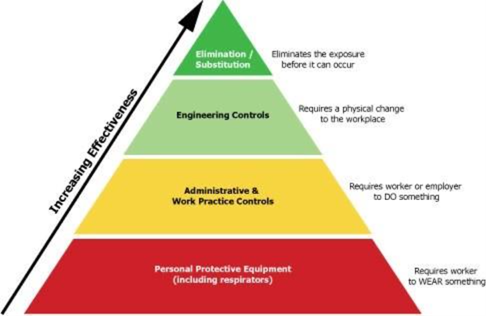
In addition to ecological benefits, OSHA highlights other motivations for substitution, such as improving worker health and safety. As they state:
“In the United States, it is estimated that chemicals are the cause of more than 190,000 illnesses and 50,000 deaths suffered annually by workers.”5
These numbers are likely underestimated due to long latency periods between chemical exposures and disease onset, unrecognized links between chemicals and illnesses, and other factors. Replacing known hazardous chemicals with safer alternatives could significantly reduce these figures.”5 Other motivations include lowering costs, avoiding regrettable substitutions, achieving regulatory compliance, and creating safer products for both consumers and the environment.6
In cell and gene therapy (CGT) manufacturing, this principle may involve using safe levels of pressure and temperature during production or designing protocols that ensure safe handling of cells and manipulation of gene.1
As we conclude this final principle of green chemistry, we hope it has inspired a deeper commitment to sustainable practices and green chemistry for both small molecule and CGT development. While the principles vary in complexity and implementation, they all share two common traits that chemists must bring to the table: planning and a willigness to challenge long-established habits.
References
- https://www.acs.org/content/acs/en/greenchemistry/principles/12-principles-of-green-chemistry.html
- P. T. Anastas, and J. Warner, Green Chemistry: Theory and Practice; Oxford University Press; New York (1998).
- US OSHA, OSHA Releases New Resources to Better Protect Workers From Hazardous Chemicals
- US OSHA,Transitioning to Safer Chemicals: A Toolkit for Employers and Workers,
- This number is derived using the methodology from “Green Chemistry in California: A Framework for Leadership in Chemicals Policy and Innovation,” (http://coeh.berkeley.edu/docs/news/06_wilson_policy.pdf *(PDF)) to estimate illness and deaths attributable to workplace chemical exposures.
- US OSHA, Why Transition to Safer Alternatives?
- F. A. Manuele, Acceptable Risk, Professional Safety, 30-38 (2010).
Resources
- https://www.acs.org/content/acs/en/greenchemistry/principles/12-design-principles-of-green-engineering.html
- https://www.epa.gov/greenchemistry/twelve-principles-green-chemistry-bookmarks